Hongik Univ. Station Exit 1 · 8F · 1:1 Personalized Aesthetic Dermatology
en-US

Fat-Dissolving Injections vs Body ONDA: Which Fits You
Chemistry against energy, five minutes against a course, two different rhythms. The clinic sets out the difference itself — here is what follows from it.

Fat-Dissolving Injections vs Body ONDA: Which Fits You
Medically reviewed by Dr. Chae-ho Lee, Medical Director, Doctorpetit Clinic Hongdae
Most comparisons on this subject have to be assembled from separate pages. This one does not, because Doctorpetit Clinic Hongdae states the distinction itself, in one sentence, inside its own description of its body-contouring category.
Lipolytic injections chemically break down fat-cell membranes; Body ONDA uses controlled microwave energy to heat and reduce subcutaneous fat while tightening skin.
Two mechanisms, and the second half of that sentence contains the difference that matters most: one of them also tightens skin, and the other does not.
Everything practical follows from those two facts.
What each one is
Fat-Dissolving Injection (Lipolysis) is described as an injectable lipolytic solution intended to chemically break down fat-cell membranes in localized, diet- and exercise-resistant areas. It is administered to selected areas such as the chin, cheeks, upper arms or abdomen, with the purpose described as breaking down and eliminating accumulated fat and improving the size and contour of the treated area.
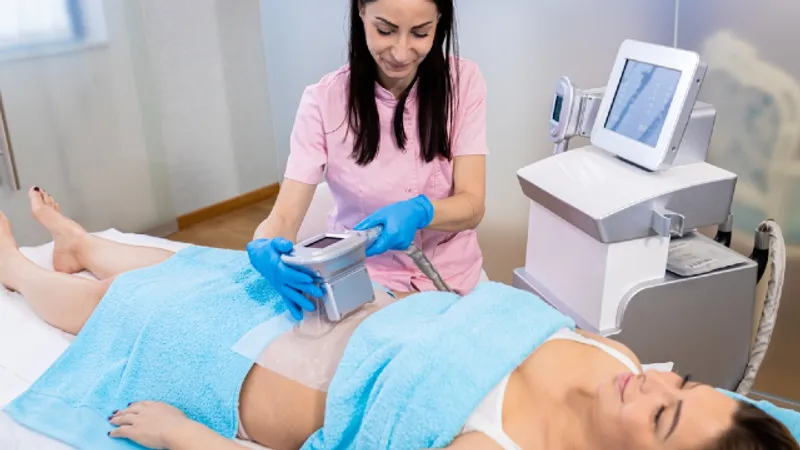
Body ONDA is described as using controlled microwave energy to heat and reduce subcutaneous fat while tightening skin — a single treatment aimed at two tissues at once.
So the question that sorts most people is not which is stronger. It is whether skin quality is part of your concern.
If what bothers you is a discrete pocket of fat on skin that is otherwise firm, an injection is aimed at that pocket. If the area is both fatty and loose — and the loose part is what you notice in photographs — then a treatment that addresses only the fat is addressing half of it.
That distinction is the clinic's own, and it is answerable by an examination rather than by a preference.
The session rhythms could not be more different
This is the second practical fork, and it decides how the treatment fits into a life.
Fat-dissolving injection: the procedure takes about 5 minutes. The clinic recommends three or more sessions at one-week intervals.
Five minutes. Weekly. That is a treatment shaped like an appointment you drop into, repeated.
Body ONDA, as the clinic describes its microwave face treatment, is a session of roughly ten to twenty minutes with recommended repeat sessions every three to four weeks depending on goals.
So both are courses, but on completely different clocks. Weekly against monthly.
For someone visiting Korea, both are honest problems. Three sessions at one-week intervals is a three-week commitment; a monthly rhythm cannot be compressed at all. The clinic's own language for the injection is that consistent treatment can provide more defined contour improvement — consistency being the operative word, and consistency being what a two-week trip cannot deliver.
A single session of either is a reasonable thing to have. It is not the course, and it should be chosen knowing that.
Timelines
Fat-dissolving injection: changes gradually appear approximately 3 to 7 days after treatment, with maintenance described as approximately 1 month, and individual variation.
That one-month figure deserves attention. It is short, and it is the clinic's own. Paired with a recommendation of three or more weekly sessions, the picture is of a treatment that works cumulatively and is maintained rather than completed.
The clinic separately describes a related injectable option with a different profile: gradual reduction beginning around 2 to 4 weeks, maintenance of approximately 3 to 6 months, and treatment repeatable at four-week intervals. If duration is what you care about, that difference is worth raising at the consultation, because the two sit in the same category and behave quite differently.
Body ONDA: subtle firming noticed early, with collagen remodeling and metabolic fat clearing unfolding across 6 to 12 weeks, and results lasting approximately 6 to 12 months.
Longer to arrive, longer to stay.
Comfort and recovery
Fat-dissolving injection: ice cooling is used to reduce discomfort. The clinic describes relatively little pain and swelling, with residual swelling generally settling within approximately 1 to 2 days. It recommends lightly massaging the injection area on the day of treatment — an unusual instruction, and one worth following precisely because most injectable aftercare says the opposite.
Body ONDA: no anesthesia or numbing cream is required, because the integrated contact cooling keeps the skin surface comfortable. Side effects are described as minimal and temporary — brief mild redness or warmth subsiding within a few hours — with no downtime. Aftercare is hydration, moisturizer, daily broad-spectrum sunscreen, and avoiding alcohol, saunas and intense heat for the first 24 to 48 hours.
On downtime, the energy treatment is the lighter of the two. One to two days of residual swelling is not much, but it is more than a few hours.
Who each one is described for
Fat-dissolving injection: adults with small, localized areas of excess fat who are generally healthy and have realistic expectations about gradual, localized contour improvement.
Body ONDA: the clinic's microwave treatment is described for mild to moderate laxity, loss of definition, and stubborn fat.
Both say localized. Neither is described as a weight treatment, and the whole body-contouring category at this clinic is framed around defined areas rather than around a number on a scale. MedlinePlus keeps general background on weight control and obesity — different subjects, addressed differently.
Who should not have them
Fat-dissolving injection: suitability may be limited by pregnancy or breastfeeding, active infection or skin disease at the injection site, certain medical conditions, allergies to treatment ingredients, or other risks the clinician identifies.
Body ONDA: active skin infections, open wounds or sores in the treatment region, severe skin laxity requiring surgical excision, or pregnancy.
Note the second item on ONDA's list. Severe laxity requiring surgery is the ceiling of the energy-based category, and it is not something an injection addresses either. If that is the finding, neither of these is the answer.
Background on the general considerations is at MedlinePlus on allergy and infection control.
What the consultation is deciding

Both are chosen after an assessment, and the two assessments look at different things.
For its injectable work, the clinic describes a one-to-one customized consultation considering individual skin condition and elasticity when designing treatments.
For its microwave treatment, it describes an individualized consultation assessing skin thickness, elasticity, and localized fat distribution before selecting energy handpieces and target depths.
Elasticity appears in both. That is not an accident — it is the variable that decides whether removing volume from an area will leave it looking better or looking emptier, and it is the thing you cannot assess from a photograph of yourself.
Which is the honest reason this comparison should not be settled before an examination. Ask directly: is my concern fat, skin, or both? A clinician who has assessed the area can answer, and the answer names the treatment.
You can send your dates and the area you are asking about ahead through the clinic's contact page, and its about page shows the other options in the same category — there are more than two, including carboxytherapy and a physician-supervised medication route, each aimed at something different again.
What neither of them is
Three clarifications, because this is the category where expectations most often exceed what is described.
Neither is surgery, and neither removes tissue mechanically. One breaks down fat-cell membranes chemically; the other heats tissue. The comparison with surgical fat removal does not hold in either direction, and the clinic does not make it.
Neither is a treatment for body weight. Both are described for localized areas, and the clinic's body-contouring category is framed around contour rather than around a number.
Neither addresses skin that has passed the point an energy device reaches. Severe laxity requiring surgical excision appears in the exclusions, and an injection does not solve it either.
Held at the right scale, both are reasonable options for a defined finding. Held at a larger one, both disappoint — and the assessment is what places your concern on that scale.
The other two in the same category
Worth naming, because a two-way comparison inside a four-option category is an artificial narrowing.
The clinic describes carboxytherapy as delivering medical carbon dioxide gas just under the skin to boost local circulation and metabolism, and diet medication as working systemically to support appetite or metabolic regulation under physician supervision.
Four different mechanisms: chemical, energy-based, circulatory, and systemic. Arriving having decided between two of them is arriving having ruled out two others without an examination.
What to ask, in order
Four questions, and the first two can be answered before you fly.
Is my concern fat, skin, or both? The single question this whole comparison turns on, and the one only an examination answers.
How many sessions would you expect, and at what interval? One is a weekly rhythm, the other monthly, and neither can be compressed into a trip.
What would you expect this to change, and what would you expect it not to? Neither of these removes tissue mechanically and neither is a weight treatment, so it is worth hearing the boundary stated out loud.
Which of the four options in this category did you rule out, and why? A recommendation that names what was set aside is a recommendation someone made rather than a menu item you picked.
The Bottom Line
The clinic states the difference itself: lipolytic injections chemically break down fat-cell membranes, while Body ONDA uses microwave energy to heat and reduce subcutaneous fat while tightening skin.
The sorting question is whether skin quality is part of your concern. Only one of the two addresses it.
The rhythms differ sharply: the injection is about 5 minutes with three or more sessions at one-week intervals; the microwave treatment repeats every three to four weeks.
The injection's changes appear at 3 to 7 days with maintenance of about a month; ONDA's develop across 6 to 12 weeks and last roughly 6 to 12 months.
Neither is a weight treatment, and neither addresses severe laxity requiring surgical excision.
Frequently Asked Questions
What is the basic difference?
The clinic states that lipolytic injections chemically break down fat-cell membranes, while Body ONDA uses controlled microwave energy to heat and reduce subcutaneous fat while tightening skin.
Which one should I choose?
It depends on whether your concern includes skin laxity. Only the energy treatment is described as tightening skin as well as reducing fat, and an examination decides which applies.
How many sessions?
The injection is recommended at three or more sessions at one-week intervals. The microwave treatment is described with repeat sessions every three to four weeks.
How soon do results appear?
Injection changes appear gradually around 3 to 7 days after treatment. The microwave treatment's firming and fat clearing unfold across 6 to 12 weeks.
Is there downtime?
The injection has residual swelling generally settling within about 1 to 2 days, with light massage recommended on the day. The microwave treatment has no downtime and effects subsiding within a few hours.
Can I complete a course on one trip?
Not realistically. Three weekly injection sessions is a three-week commitment, and a three-to-four-week repeat interval cannot be compressed.
Are these weight-loss treatments?
No. Both are described for localized areas, and neither is presented as a treatment for body weight.
This article is for general informational purposes and does not constitute individualized medical advice. It is not a self-diagnosis tool. Which option suits your concern can only be determined through a consultation with a qualified dermatologist or other appropriately qualified clinician who has examined you in person.
Academic & Clinical Sources
- U.S. Food and Drug Administration — Non-Invasive Body Contouring Technologies
- U.S. Food and Drug Administration — Aesthetic (Cosmetic) Devices
- MedlinePlus — Weight Control
- MedlinePlus — Obesity
- MedlinePlus — Allergy
- MedlinePlus — Infection Control
- MedlinePlus — Bruises
Ready for Your Personalized Aesthetic Consultation in Hongdae?
Located right at Hongik Univ. Station Exit 1 (8F, 151 Yanghwa-ro, Mapo-gu). Multilingual coordinators for English, Traditional Chinese, and Simplified Chinese patients.