Hongik Univ. Station Exit 1 · 8F · 1:1 Personalized Aesthetic Dermatology
en-US

Hyperhidrosis: How Botox Treats Excessive Sweating
A medical condition treated at an aesthetic clinic. Why the cause has to be established first, and why it runs on a slower clock than facial Botox does.

Hyperhidrosis: How Botox Treats Excessive Sweating
Medically reviewed by Dr. Chae-ho Lee, Medical Director, Doctorpetit Clinic Hongdae
Most of what an aesthetic clinic offers is about appearance. This one is not, quite.
Excessive sweating is a medical condition that gets treated in aesthetic settings because the tool that works for it — botulinum toxin — happens to live there. But it behaves differently from everything else on the menu: it treats a symptom rather than a look, its candidacy is defined by interference with daily life rather than by an aesthetic goal, and it runs on a noticeably slower clock than facial treatment.
Understanding those differences is most of what a patient needs.
What the treatment does
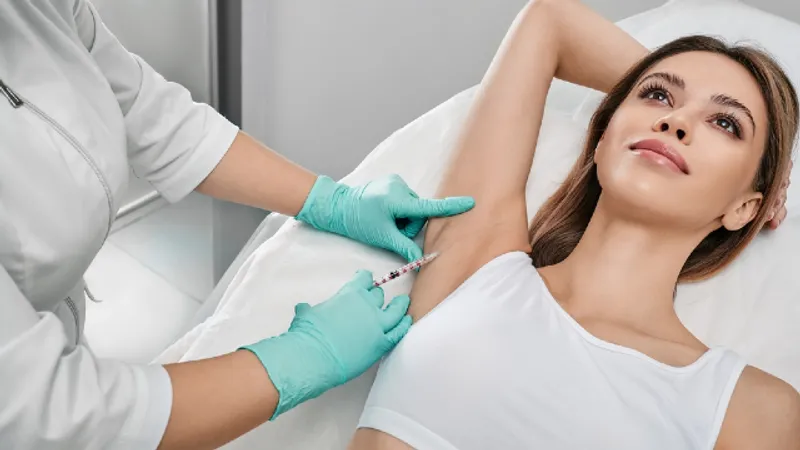
Doctorpetit Clinic Hongdae describes Hyperhidrosis Botox as a minimally invasive treatment using botulinum toxin to temporarily reduce excessive sweating, usable in sweat-prone areas such as the underarms, palms, and soles of the feet.
The mechanism, as the clinic states it: botulinum toxin works by temporarily blocking the nerve signals that stimulate sweat glands, reducing sweat production in the treated area.
That sentence is worth reading closely, because it explains both what the treatment can do and what it cannot. The signal is interrupted; the gland is not removed. So the effect is local, complete only where it was injected, and temporary by construction. Sweating elsewhere on the body is unchanged — which is the point, since sweating is how a body cools itself.
What hyperhidrosis actually is
Sweating is normal and necessary. Hyperhidrosis is sweating well beyond what temperature or exertion calls for — persistent enough that it interferes with ordinary life. The U.S. National Library of Medicine keeps a general overview at MedlinePlus on sweat.
The clinical distinction that matters most is between primary hyperhidrosis, where excessive sweating is the condition itself, and secondary hyperhidrosis, where it is a symptom of something else — another medical condition, or a medication.
The clinic states this explicitly in its candidacy description: a medical evaluation may be appropriate to determine whether excessive sweating is primary hyperhidrosis or related to another medical condition or medication.
That is the first question, and it is not an aesthetic one. Treating the sweating of an undiagnosed underlying condition suppresses a signal without addressing what is producing it. If nobody has asked you this, ask it yourself.
Who it is described for
The clinic's candidate description is specific in a way that is worth quoting closely.
Suitable candidates are adults with localized excessive sweating in areas such as the underarms, palms or soles, particularly when sweating is persistent and affects daily life. Candidates should have realistic expectations that the treatment provides temporary reduction rather than a permanent cure.
Three qualifiers, each doing work.
Localized. This is a treatment applied to defined areas. Generalized sweating over the whole body is a different problem and this is not the instrument for it.
Affects daily life. The clinic's own account of why patients seek it names sweating that interferes with daily activities, work, social interactions, or comfort. That is the threshold — not embarrassment about a warm day.
Temporary reduction, not a cure. Written into the candidacy criteria rather than appended as a disclaimer, which is the right place for it. Anyone hoping to solve this permanently should know before the first appointment that the clinic is not describing that.
The timeline, which is not the facial one
If you know how facial Botox behaves, unlearn the numbers.
Onset: 3 to 7 days. Sweat reduction begins gradually in that window.
Maximum effect: around one month. Not two weeks — a month. This is the figure most likely to cause an unnecessary worry at week two, when a facial patient would already be at peak effect and this patient is roughly halfway there.
Duration: approximately 3 to 6 months, with individual differences, and a recommended treatment cycle of roughly every three to six months.
Compare that with the clinic's facial services — its wrinkle treatment is published at around two to three months, its expression-area treatment at three to four. Sweat treatment is the longer-lasting end, and the peak arrives later. Both differences follow from treating a gland rather than a muscle.
The appointment itself is short: approximately 10 to 15 minutes, with same-day recovery, and no routine overnight stay for injectable treatment.
What the appointment involves
Six steps, and the third is not one every botulinum toxin service uses.
Consultation and assessment of the affected areas; the skin cleansed and treatment points marked; numbing cream or local anesthesia used for comfort; injection into the targeted sweat glands; the nerve signals that trigger sweating temporarily reduced; and the area checked with post-treatment instructions given.
On comfort, the clinic is direct: anesthetic cream is applied before treatment and ice cooling is used, because pain may occur. General anesthesia or IV sedation is not typically required.
That phrasing — "because pain may occur" — is more candid than most. Palms and soles are densely innervated, and a treatment there is a different experience from a few injections in a forehead. Expect the numbing step to be part of it, and expect the appointment to be longer than the ten-to-fifteen-minute injection time because of it. MedlinePlus keeps general background at anesthesia.
The consultation reviews the location, severity and pattern of your sweating, alongside medical history, medications, allergies and previous treatments, and assesses whether localized botulinum toxin is appropriate for the area.
The risk specific to palms
Most of the possible effects are the ordinary injection-site ones: temporary pain, redness, swelling, bruising or tenderness.
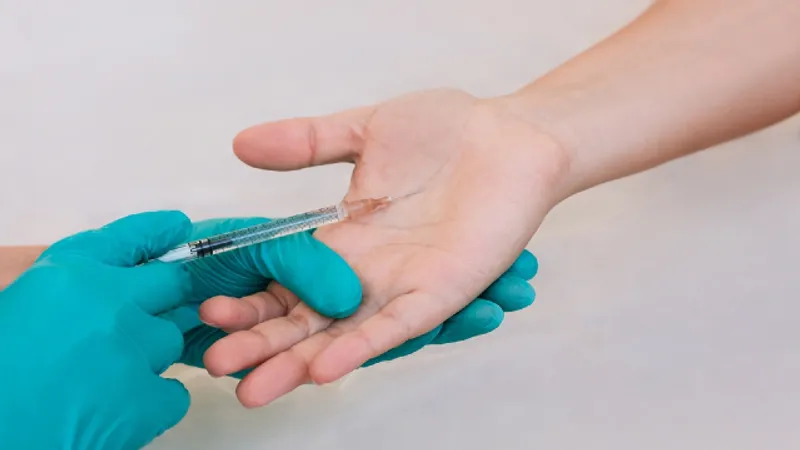
One is particular to this treatment and deserves its own line. The clinic states that depending on the treatment area, temporary muscle weakness may occur, and that palm treatment can potentially affect nearby hand-muscle function.
Hands do fine work. Temporary weakness of a hand muscle is a different inconvenience from temporary weakness of a forehead muscle, and anyone whose work or hobby depends on grip or precision should raise it before treatment rather than discover it afterward. It is temporary. It is also worth timing around.
The clinic also notes that rarely, botulinum toxin can cause more widespread effects, and that significant difficulty swallowing, speaking or breathing requires urgent medical attention. That is emergency care, not a message to the clinic.
The three areas are not one decision
The clinic names underarms, palms and soles together, but they behave differently enough that treating them as a single choice is a mistake.
Underarms are the straightforward case. There is no fine motor function underneath, clothing covers the area, and the practical consequence of the treatment is limited to the treatment itself.
Palms carry the hand-muscle consideration described below, and they are also the most sensitive of the three to inject, which is part of why the clinic's comfort protocol exists in the form it does.
Soles bear weight all day, and any injection there is followed by walking on it.
If more than one area is on your list, ask whether they should be done together or separately. That is a clinical judgment, and it is also a practical one about how much of your week you want to spend recovering from a treatment that is described as having little downtime.
Who should not have it
Potential exclusions: known hypersensitivity to botulinum toxin or its ingredients, certain neuromuscular disorders, infection or inflammation at the injection site, or medical conditions that increase treatment risk. Pregnancy and breastfeeding should be discussed with a healthcare professional, because safety data for elective use are limited.
That last clause is unusually honest phrasing and worth taking at face value: the reason for caution is absence of evidence, not presence of harm.
Before treatment, disclose medications, supplements, allergies, neuromuscular conditions and previous botulinum toxin treatments. The clinician may review medicines or supplements that can increase bruising — which is a disclosure request, not an instruction to stop anything. MedlinePlus covers the general category at drug safety and neuromuscular disorders. Routine fasting is generally not required when treatment is performed without sedation.
Afterward
Patients can generally resume routine activities after treatment, following instructions about rubbing, pressure and exercise involving the treated areas. Contact the clinic if you develop unusual weakness, significant swelling, infection or other unexpected symptoms.
Mild injection-site discomfort or bruising may occur temporarily and is on the expected list. Bruises behave the same way here as anywhere.
Planning it around a trip
The appointment is short and same-day recovery is possible, so the treatment itself fits easily into a visit. The clinic notes that international patients should confirm individual travel and follow-up arrangements.
The complication is the same one that affects every slow-onset treatment, only more so. Maximum effect at around one month means you will be home long before you know how well it worked, and if a patch of an underarm was missed, you will discover it in week three at the earliest.
So settle two things before you leave: what the clinic considers a normal amount of residual sweating at one month, and what the route back is if the answer turns out to be less than you hoped. The clinic's contact page is the channel it names for patient inquiries, and agreeing the expectation in advance turns an uncertain month into a scheduled wait.
What it is reasonable to expect
The clinic's stated benefits are measured, and reading them in its own register is useful: reduced excessive sweating, fewer visible sweat marks, improved comfort during daily activities, greater confidence in social or professional situations, and a localized non-surgical option.
Nothing there says dry. It says reduced.
For a condition that is genuinely disruptive, reduced for three to six months at a time is a real change in how a year feels. For someone who sweats normally and dislikes it, it is a treatment aimed at a problem they do not have. The difference between those two people is what the consultation is for, and the clinic's about page shows how this service sits within the rest of its botulinum toxin menu.
The Bottom Line
The clinic describes this as temporarily blocking the nerve signals that stimulate sweat glands, used for the underarms, palms and soles.
The first question is medical: whether the sweating is primary hyperhidrosis or secondary to another condition or medication. The clinic says a medical evaluation may be appropriate to establish that.
Candidacy is localized, persistent sweating that affects daily life, with realistic expectations of temporary reduction rather than a cure.
The clock is slower than facial Botox: onset at 3 to 7 days, maximum effect at around one month, lasting approximately 3 to 6 months.
Palm treatment can potentially affect nearby hand-muscle function temporarily — worth timing around if your work depends on grip.
Frequently Asked Questions
How does Botox stop sweating?
The clinic describes it as temporarily blocking the nerve signals that stimulate sweat glands, reducing sweat production in the treated area. The glands are not removed.
Which areas can be treated?
The clinic names sweat-prone areas such as the underarms, palms, and soles of the feet.
How long does it take to work?
Sweat reduction begins gradually 3 to 7 days after treatment, with maximum effects at around one month — later than facial Botox reaches its peak.
How long does it last?
Approximately 3 to 6 months by the clinic's account, with individual differences, and a recommended treatment cycle of roughly every 3 to 6 months.
Is it painful?
The clinic applies anesthetic cream before treatment and uses ice cooling, stating plainly that pain may occur. General anesthesia or sedation is not typically required.
Can it affect my hands?
The clinic states that palm treatment can potentially affect nearby hand-muscle function temporarily, alongside possible temporary muscle weakness depending on the area treated.
Is this a permanent cure?
No. The clinic writes realistic expectations of temporary reduction rather than a permanent cure directly into its candidacy criteria.
This article is for general informational purposes and does not constitute individualized medical advice. It is not a self-diagnosis tool. Whether this treatment suits you, and whether your sweating needs medical evaluation first, can only be determined through a consultation with a qualified dermatologist or other appropriately qualified clinician who has examined you in person.
Academic & Clinical Sources
- MedlinePlus — Sweat
- MedlinePlus — Botox
- MedlinePlus — Anesthesia
- MedlinePlus — Neuromuscular Disorders
- MedlinePlus — Drug Safety
- MedlinePlus — Bruises
- MedlinePlus — Talking With Your Doctor
Ready for Your Personalized Aesthetic Consultation in Hongdae?
Located right at Hongik Univ. Station Exit 1 (8F, 151 Yanghwa-ro, Mapo-gu). Multilingual coordinators for English, Traditional Chinese, and Simplified Chinese patients.